





 Larry Olson | CMRP, CRL, CAMA
The Maintenance Optimization Lifecycle: Project vs Capability
 Larry Olson | CMRP, CRL, CAMA
Explore the lifecycle of maintenance optimization and learn why treating it as a capability, not just a project, is key to sustaining long-term...

Planned Maintenance Optimization (PMO) can reduce maintenance costs, improve reliability, and eliminate unnecessary work—but what happens after the optimization project ends?
For many organizations, the initial gains don't disappear overnight. They slowly erode as maintenance tasks creep back in, ownership fades, and optimized strategies lose the governance needed to keep them effective.
The real challenge isn't achieving optimization. It's sustaining it.
Executive Summary
Planned Maintenance Optimization (PMO) is one of the highest-return initiatives available to asset-intensive organizations. When executed effectively, it reduces maintenance cost, improves asset reliability, and drives measurable operational performance.
However, despite strong initial results, many organizations experience a gradual erosion of value over time.
This is not due to poor execution. It is due to a lack of sustainment.
Across multiple sectors, a consistent lifecycle is observed:
This pattern is systemic and predictable.
Most PMO initiatives are technically sound. The failure occurs after the project concludes. Optimization is delivered—but it is not sustained.
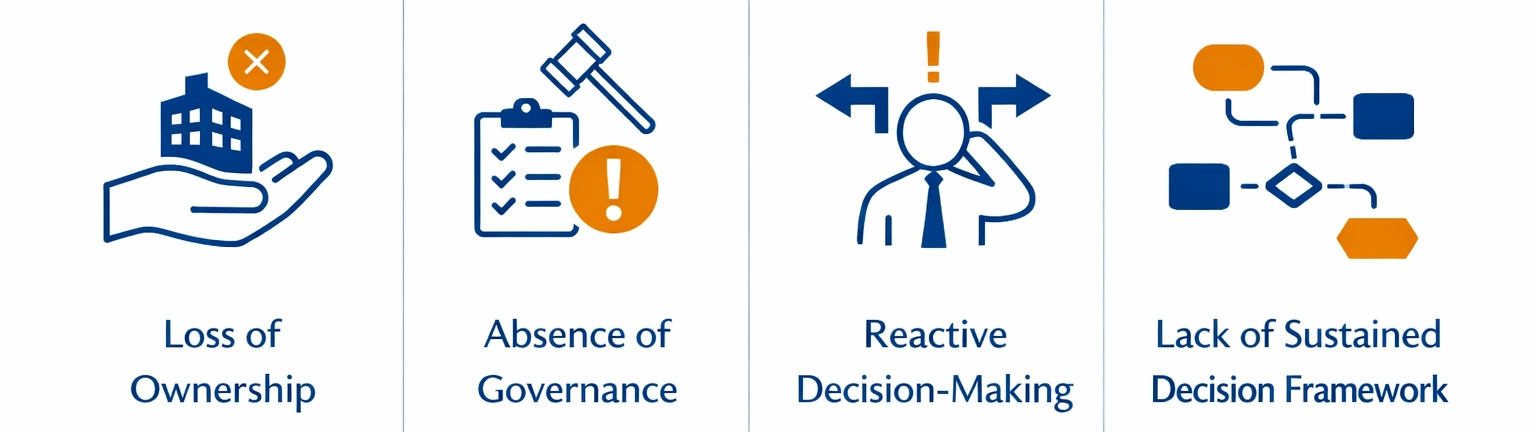
Loss of Ownership
Absence of Governance
Reactive Decision-Making
Lack of Sustained Decision Framework
Tasks are gradually added over time without removing existing ones, rebuilding inefficiencies.
A Structural Gap in the Industry
PM optimization has been treated as a project or engagement. In reality, it is a continuous requirement.
Conclusion
Planned Maintenance Optimization remains a critical lever for improving reliability and reducing cost.
However, its long-term value is not determined by the quality of initial delivery.
It is determined by the organization’s ability to sustain and govern optimization over time. For this reason, Nexus Global has introduced an industry first, Planned Maintenance Optimization as a Service (PMOaaS).
Explore the lifecycle of maintenance optimization and learn why treating it as a capability, not just a project, is key to sustaining long-term...
Discover how a major coal producer optimized their maintenance strategy for a new mining system within five weeks, ensuring efficiency and...
Reactive Maintenance costs 3-4x more than Preventive Maintenance. Maintaining assets and determining downtime using proactive strategies is essential.
 Doug Robey | CMRP, CRL
 Nexus Global